Wall Street closes at a record for the first time since end of January
Investing.com -- Morgan Stanley analysts are pushing back on the software sector’s reaction to the rise of managed AI agents, arguing that the selloff in cloud infrastructure stocks misreads how the technology actually works.
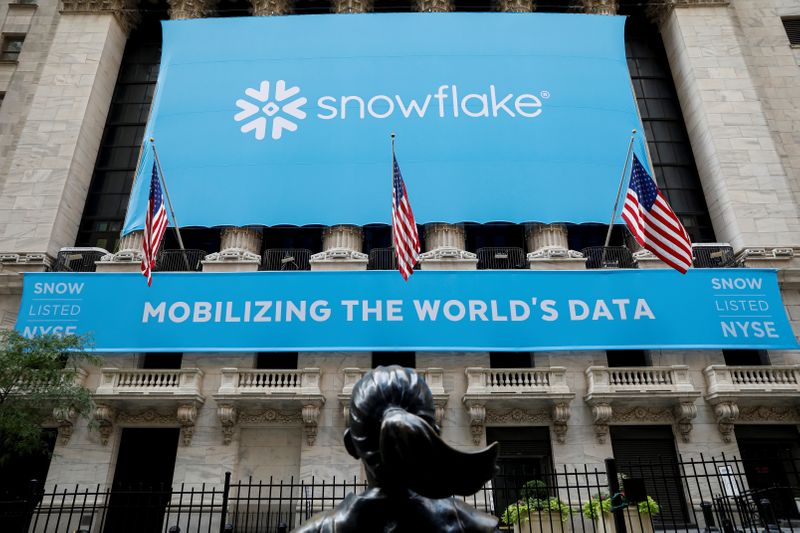
Shares across the bank’s infrastructure coverage took a beating over the past week, with the likes of Cloudflare, Akamai, Snowflake, Datadog, Dynatrade, and Elastic all seeing sharp declines.
The selloff followed the arrival of managed agent offerings from AI-native companies, which investors interpreted as a direct competitive threat to cloud infrastructure software.
But analysts at Morgan Stanley disagree with that view, arguing that while managed agent platforms do absorb the orchestration layer — handling model calls, tool routing, and keeping agent workflows running — the execution work gets pushed outward, not eliminated.
"The point is that managed agents abstract away the complexity of coordinating agents, but still depend on external execution, data, network services, and observability to make agents useful," the analysts led by Sanjit Singh wrote.
The opportunity, they continued, lies in what happens when agents actually run at scale.
The analysts believe that a world enabling "millions, billion or even trillions of AI agents, each of which has the potential to call multiple tools, access governed data sources, execute web searches and download content" would fundamentally reshape demand across the infrastructure stack.
For Content Delivery Networks (CDNs) and edge compute providers like Akamai and Cloudflare, the team sees agent workloads as a volume multiplier, driving more web searches, application traffic, and demand for caching, routing, and security services.
Multi-step agentic workflows are also sensitive to latency in ways that increase the value of edge infrastructure.
Morgan Stanley cited an Akamai blog post noting that a London-to-Virginia inference path adds roughly 28 milliseconds each way before a single token is generated — a delay that compounds with each sequential tool call.
“In other words, every extra model hop and tool call increases the value of proximity, caching, request routing, and traffic control at the edge,” the analysts explained.
Data platforms such as Snowflake, MongoDB, and Palantir could also benefit as managed agent sessions require governed access to enterprise data, the analysts suggested.
For Snowflake, agent connections via MCP would invoke its SQL query engine, driving compute consumption while keeping enterprise security controls intact, while Palantir’s Ontology MCP would similarly allow agents to execute workflows and analyze real-time data, which the company could monetize.
For observability-focused platforms, the analysts believe that more autonomous agents mean more complexity and more surface area to monitor.
"The proliferation of long-running, autonomous agents increases application architecture complexity and expands the surface areas of monitoring," they wrote, pointing to tool failures, latency spikes, token overruns, and policy violations as drivers of continued demand for platforms like Datadog and Dynatrace.